
Organized by: Department of Botany, Jagannath Barooah University, Jorhat, Assam
Date: 16th–17th March, 2026
Sponsored by: Council of Scientific and Industrial Research (CSIR) & Assam Pollution Control Board (APCB)
1. Introduction
The Department of Botany, Jagannath Barooah University, Jorhat, Assam, successfully organized a two-day National Seminar on “Plants and Microbes for a Sustainable Environment (NSPMSE-26)” on 16th and 17th March, 2026.
The seminar aimed to provide an academic platform for scientists, academicians, researchers, and students to exchange knowledge and ideas on the role of plant and microbial systems in achieving environmental sustainability. The programme emphasized interdisciplinary research approaches to address emerging ecological challenges.
2. Objectives of the Seminar
The key objectives of the seminar were:
- To promote research on plant and microbial applications in environmental sustainability
- To facilitate academic interaction among scientists, academicians, and research scholars
- To explore innovative solutions to environmental issues such as pollution, biodiversity loss, and climate change
- To encourage the integration of traditional knowledge with modern scientific advancements
3. Inaugural Session
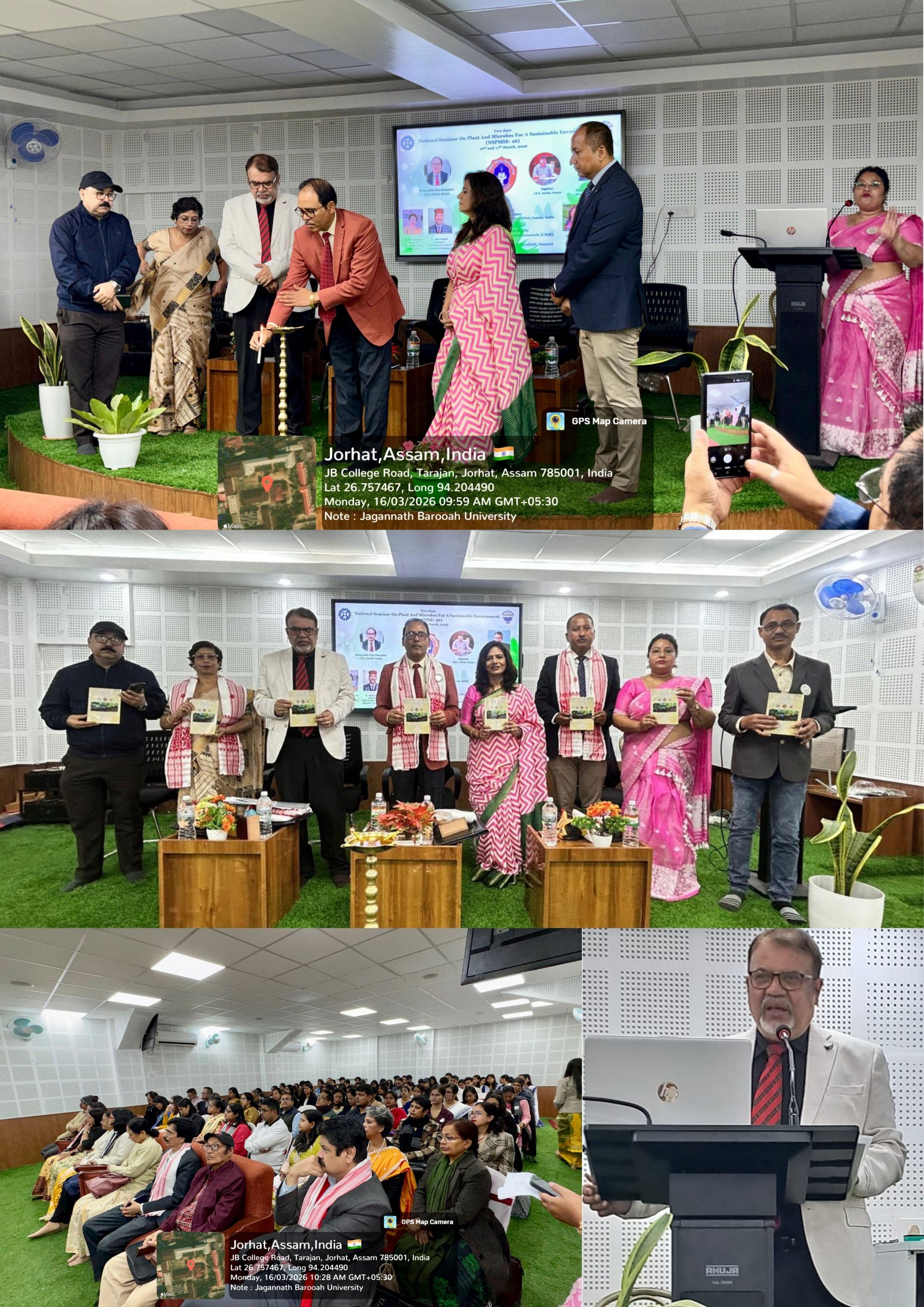
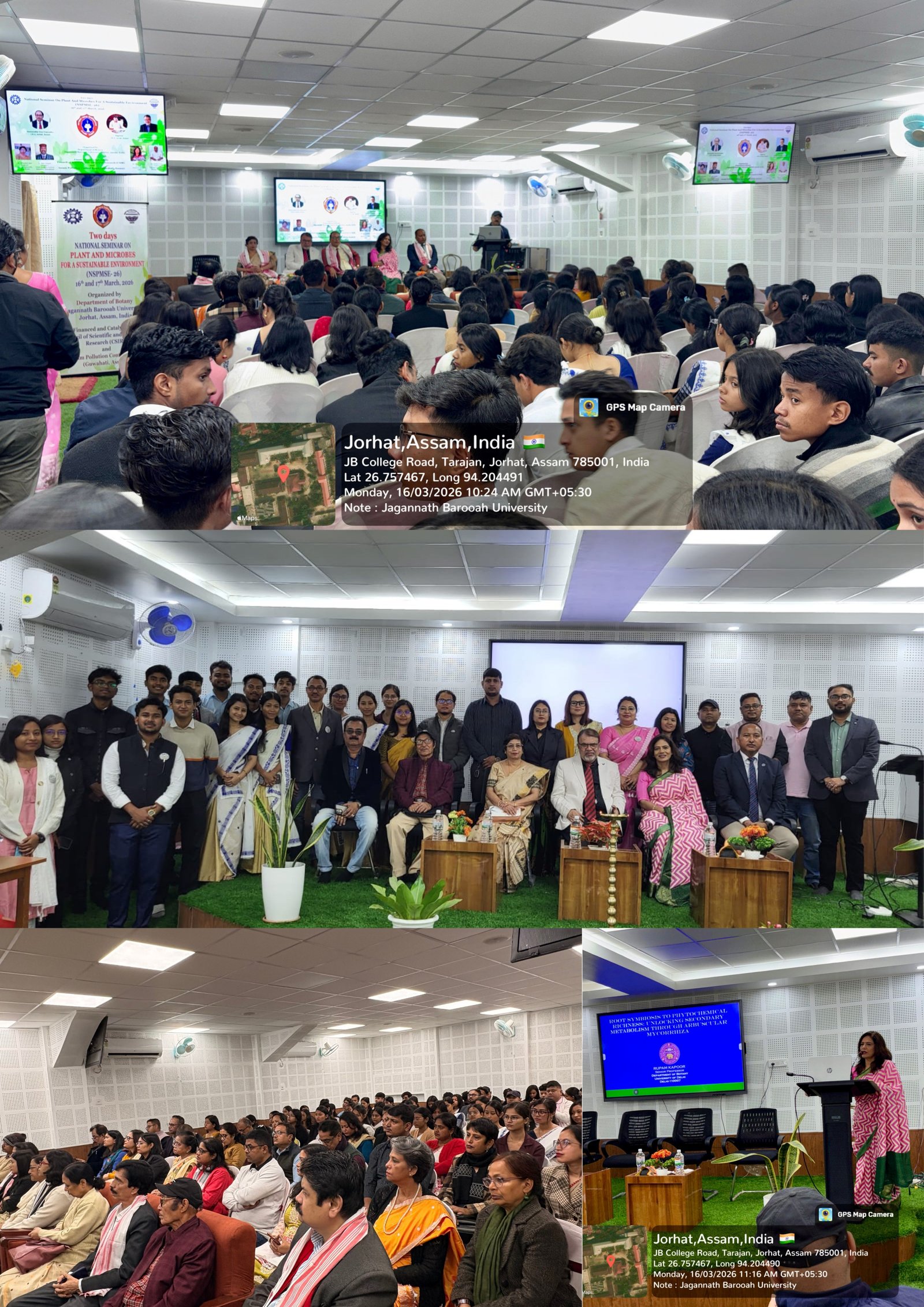
The inaugural session was held on 16th March 2026 at the New Conference Hall of the University.
The programme was inaugurated by Prof. Jyoti Prasad Saikia, Honourable Vice Chancellor of Jagannath Barooah University. In his inaugural address, he emphasized the importance of scientific innovation and interdisciplinary collaboration in addressing environmental challenges.
Dr. Utpal Jyoti Mahanta, Registrar of the University, delivered the welcome address highlighting the significance and objectives of the seminar.
The Invited Chief Guest, Dr. A.K. Misra, Chairman of the Assam Pollution Control Board, delivered an insightful address focusing on environmental governance and sustainable policy frameworks.
The keynote address was delivered by Prof. Rupam Kapoor, University of Delhi, on “Root Symbiosis to Phytochemical Richness”, emphasizing the ecological importance of Arbuscular Mycorrhizal associations.
Dr. Vipin Parkash, Forest Research Institute, Dehradun, presented on the role of Arbuscular Mycorrhizal fungi in enhancing plant health and forest sustainability.
A special presentation was delivered by Dr. Anuradha Gogoi on urban air pollution status and management strategies in Jorhat.
The session was conducted by Dr. Liza Handique Bhattacharyya and concluded with a vote of thanks by Mr. Bubul Ch. Neog.
4. Technical Sessions
- The seminar featured seven (07) technical sessions, conducted in both offline and online modes.
- A total of 80 research papers were presented by participants from various institutions across the country.
Major Themes Covered:
- Antimicrobial resistance and environmental drivers
- Indigenous medicinal plants and Sustainable Development Goals (SDGs)
- Nanotechnology in pollution control and catalysis
- Bioprospecting and microbial diversity
- Plastic-degrading bacteria and waste management
- Agro-waste utilization and sustainable agriculture
- Molecular approaches to plant stress management
- Wetland hydrochemistry and environmental monitoring
- Air quality assessment and management
Session Highlights:
The sessions were chaired by eminent academicians from reputed institutions such as Dibrugarh University, Gauhati University, Majuli University of Culture, University of Delhi, and ICFRE.
Notable presentations included:
- Dr. Pankaj Chetia on antimicrobial resistance
- Dr. Bhaskar Jyoti Sarmah on modified clay-supported metal nanoparticles
5. Participation
The seminar witnessed active participation from faculty members, scientists, research scholars, and students from various institutions including CSIR-NEIST, state universities, and national research organizations.
The hybrid mode (offline and online) ensured wider accessibility and participation from different parts of the country.
6. Valedictory Session
The seminar concluded on 17th March 2026 with a Valedictory Session held at the New Conference Hall.
The session reviewed the key outcomes of the seminar and emphasized the need for continued research collaboration in the field of environmental sustainability.
The programme concluded with a Cultural Programme, marking the successful completion of the seminar.