
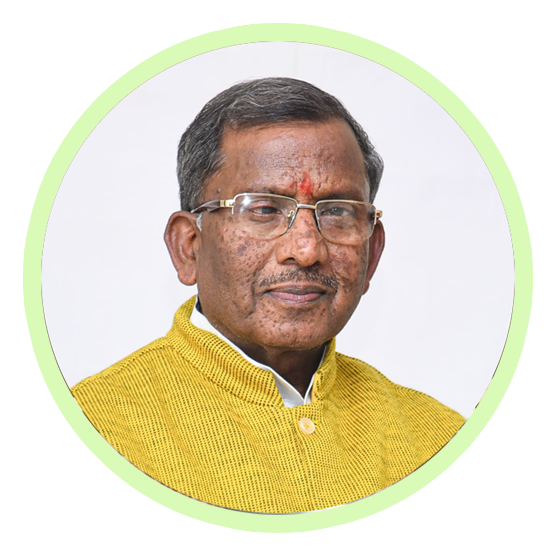
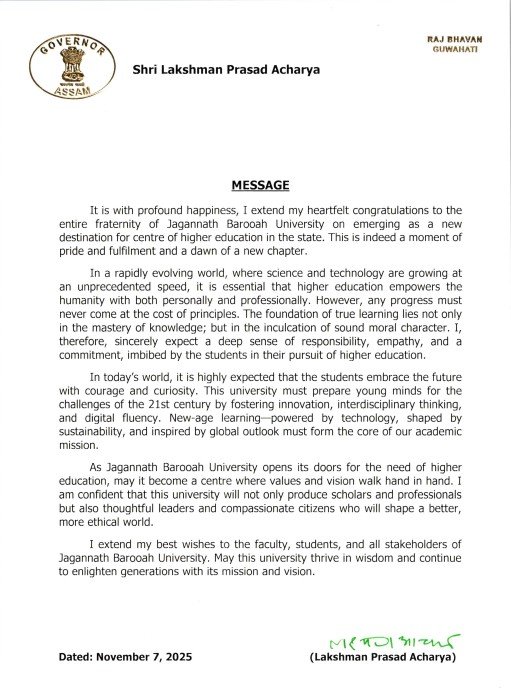
The Hon’ble Shri Lakshman Prasad Acharya, Governor of Assam, serves as the Chancellor of Jagannath Barooah University. He assumed office as the 32nd Governor of Assam on 30th July 2024. Prior to this, he held the esteemed position of Governor of Sikkim.
|
Sr. No. |
Title |
Subtitle |
Links on Website |
|
1 |
About HEI |
About Us- Overview: |
https://jbu.ac.in/index.php/about-us/the-jb-university |
|
Act and Statutes or MoA |
To be approved | ||
|
Institutional Development Plan |
https://jbu.ac.in/index.php/about-us/strategic-plan | ||
|
Constituent Units/ Affiliated Colleges, Affiliating University (In case of |
To be approved |
||
|
Accreditation/ Ranking Status (NAAC, NBA, NIRF) |
To be approved | ||
|
Recognition / Approval (2(f), 12B, etc. as applicable) |
https://jbu.ac.in/images/aboutuscontent/2fnotificationJagannathBarooahUniversity.pdf |
||
|
Annual Reports |
https://jbu.ac.in/index.php/management/reports | ||
|
Annual Accounts Including Balance Sheet, Income and Expenditure Account, |
https://jbu.ac.in/index.php/management/finance | ||
|
Sponsoring Body Details, if any |
Govt. of Assam. |
||
|
2 |
Administration (Profiles with Photographs |
Chancellor |
https://jbu.ac.in/index.php/administration/chancellor |
|
Pro Chancellor |
|||
|
Vice-Chancellor |
https://jbu.ac.in/index.php/administration/vice-chancellor | ||
|
Pro Vice-Chancellor |
|||
|
Registrar |
https://jbu.ac.in/index.php/administration/registrar | ||
|
Principal (wherever applicable) |
|||
|
Finance Officer |
To be approved | ||
|
Controller Of Examination |
To be approved | ||
|
Chief Vigilance Officer |
To be approved | ||
|
Ombudsperson |
To be approved | ||
|
Executive Council/Board of |
https://jbu.ac.in/index.php/management/governing-body | ||
|
Board of Management |
https://jbu.ac.in/index.php/management/governing-body | ||
|
Academic Council |
https://jbu.ac.in/index.php/management/academic-council | ||
|
Board of Studies |
|||
|
Finance Committee – |
https://jbu.ac.in/index.php/management/committees-cells | ||
|
Internal Complaint Committee |
https://jbu.ac.in/index.php/management/committees-cells | ||
|
Academic Leadership (Dean/Hod of |
https://jbu.ac.in/index.php/administration/deans | ||
|
3 |
Academics |
Details of Academic Programs |
https://jbu.ac.in/index.php/academics/programmes-offered |
|
Academic Calendar |
https://jbu.ac.in/index.php/academics/academic-calendar | ||
|
Statutes/Ordinances Pertaining to |
|||
|
Schools /Departments/ Centres |
https://jbu.ac.in/index.php/facultiess-registered/assamese# | ||
|
Department/ School/ Centre Wise Faculty/ Staff Details with Photographs |
https://jbu.ac.in/index.php/facultiess-registered/assamese# | ||
|
List of UGC-Recognized ODL/Online Programs, if any |
|||
|
Internal Quality Assurance Cell (IQAC) |
|||
|
Library |
http://jbcollege-opac.kohacloud.org/ | ||
|
Academic Collaborations |
|||
|
4 |
Admissions & Fee |
Prospectus (including fee structure for various programs) |
|
|
Admission Process and Guidelines |
https://jbu.ac.in/index.php/academics/admission-procedure | ||
|
Fee Refund Policy |
To be approved | ||
|
5 |
Research |
Research And Development Cell (Including Research and Consultancy Projects, Foreign Collaboration Industry |
|
|
Incubation Centre/Start-Ups/ Entrepreneurship Cell |
|||
|
Central Facilities |
|||
|
6 |
Student Life |
Sports Facilities |
https://jbu.ac.in/index.php/facilities/sports |
|
NCC/NSS - Details |
|||
|
Hostel Details (Wherever Applicable) |
https://jbu.ac.in/index.php/facilities/hostel | ||
|
Placement Cell and Its Activities |
|||
|
Details Of Student Grievance Redressal Committee (SGRC) And Ombudsperson |
|||
|
Health Facilities |
|||
|
Internal Complaint Committee |
|||
|
Anti-Ragging Cell |
|||
|
Equal Opportunity Cell |
|||
|
Socio-Economically |
|||
|
Facilities for Differently Abled (e.g., Barrier-Free |
|||
|
7 |
Alumni |
Alumni Association with Details |
|
|
8 |
Information Corner |
RTI: Details of Central Public Information Officer (CPIO) |
|
|
Circulars and Notices |
|||
|
Announcements |
|||
|
Newsletters |
|||
|
News, Recent Events & Achievements |
|||
|
Job Openings |
|||
|
Reservation Roster (wherever applicable) |
|||
|
Study in India |
|||
|
Admission procedure and facilities provided to |
|||
|
9 |
Picture Gallery |
Picture Gallery |
|
|
10 |
Contact Us |
Details with Phone Number, |
https://jbu.ac.in/index.php/contact-us |
|
Telephone Directory |
VISION:
Centre of Quality Higher Education and Excellence for Development of Human Resource.
MISSION:
Nurture Knowledge, Skill and Attitude in Individuals through a Curriculum Responsive to the Socio-Economic and Cultural Realities.
CORE VALUES:
The rapid technological development at the national and international level, coupled with the privatization, liberalization and globalization processes, have brought in radical changes in the higher education sector in India. It has became imperative that institutions of HE adapt with the demands of these changes and, at the same time, face the challenges of the transitional period to be relevant in the present day social scenario. A holistic and integrated approach is of paramount importance in this regard.
The core values of an institution reflect its basic approach to education. Jagannath Barooah College, Jorhat has adopted the following core values:
(i) Contributing to National Development
The role of the institute primarily focus in human resource development and capacity building of individuals, to cater to the needs of the economy, society and the country as a whole, thereby, contributing to the development of the Nation. Serving the cause of social justice, ensuring equity and increasing access to higher education are a few ways by which it endeavors to contribute to the national development.
ii) Fostering Global Competencies among Students
The emerging developments at the national and global level necessitated the skill development of students, at par with their counterparts elsewhere in the world. With liberalization and globalization of economic activities, the need to develop skilled human resources of a high calibre is imperative. Consequently, the demand for internationally acceptable standards in higher education is evident. Therefore, the institute focuses in preparing the students to achieve core competencies, to face the global challenges successfully. The institute has to be innovative, creative and entrepreneurial in their approach.
(iii) Inculcating a Value System among Students
The institute tries to shoulder the responsibility of inculcating desirable value systems among students. In a country like India, with cultural pluralities and diversities, it is essential that students imbibe the appropriate values commensurate with social, cultural, economic and environmental realities, at the local, national
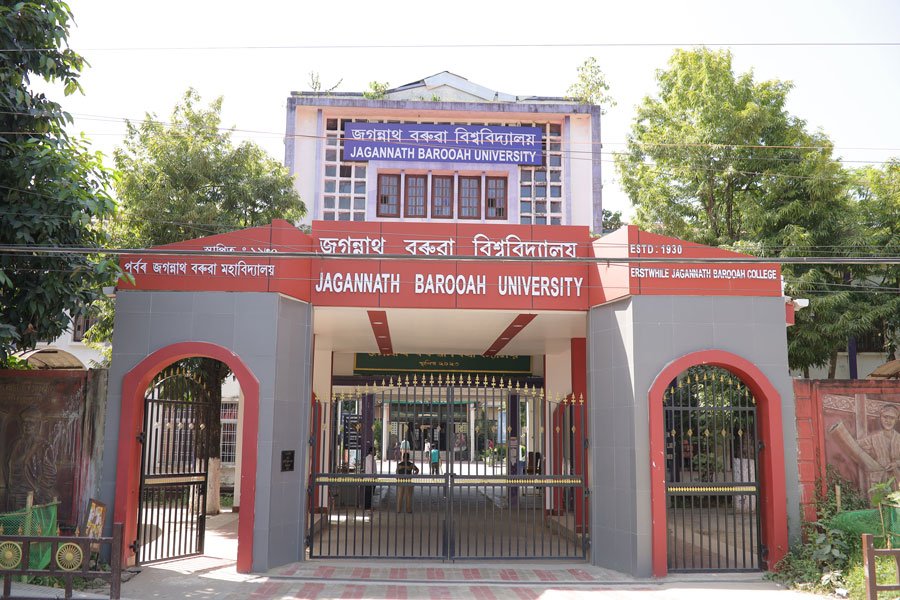
Jagannath Barooah University (Formerly Jagannath Barooah College) is a State university under Jagannath Barooah University Act 2023 of Government of Assam and recognized by UGC under section 2(f). JBU is a premier institution of higher education located in Jorhat, a city with a rich cultural heritage and a glorious historical background in the upper part of the Brahmaputra Valley of Assam. The development of modern education in colonial Assam has a close connection with the establishment of this institution at Jorhat in 1930. After 95 years of its glorious existence, it has become the hub for educational excellence, fostering its vision and mission in tune with the objectives of Higher Education of the nation. It has contributed substantially towards nation building process, promoting global competency, emphasizing continuous up gradation of teaching learning methods and techniques. It puts its best endeavor to materialize the dreams of its stakeholders through its innovative practices, programmes and policies.
The institution has already been reaccredited by NAAC in 2011 and awarded “A” grade on the basis of its performance in the field of higher education. J.B. College has also been conferred fresh autonomous status by the UGC with effect from 2016-17. Moreover, the star status has been awarded to the college by the Department of Bio-Technology, Ministry of Science & Technology, Govt. of India.
Behind the establishment of this premier seat of higher education lies the selfless and enthusiastic commitment of a tiny but highly learned group of scholars of this culturally rich city who, in fact, shaped the destiny of the academic milieu of the North East region in general and the entire Brahmaputra valley in particular. The valuable contributions made by this dedicated group had subsequently led to the formal initiation of an institution known as Upper Assam College in Jorhat in 19th August 1930. Less than a month later, i.e., on 4th September 1930, the first Governing Body (GB) Meeting of the Upper Assam College resolved to name the college as Jorhat College and this continued till 1938 when, in a resolution of another GB Meeting, it was again decided to rename the college as Jagannath Barooah College in the memory of Jagannath Barooah, the first Graduate of Upper Assam. Late Murulidhar Barooah, the grand-son of Jagannath Barooah donated the entire land and the Barpatra Kutir (existing office and teachers’ common room) to the college. The founder principal of this oldest institution of the region was Prof. Krishna Kanta Handique, world renowned Orientalist, distinguished scholar and academician. The other dedicated founder teachers were Prof. Tulshi Narayan Sarma (Founder Secretary), Jagneswar Sarma, Phanidhar Dutta, Prafulla Pran Changkakati and Gunagobinda Dutta. With a small batch of 14 students in 1930, the college was started first with Intermediate of Arts (IA) which received formal affiliation from Calcutta University in 1931. Thereafter, the events of the college moved rapidly. In 1939, the Intermediate of Commerce (I.Com.), in 1941 the Bachelor of Arts (B.A.), in 1944 the Bachelor of Commerce (B.Com.), in 1949-50 the Intermediate of Science (I.Sc.) and in 1952-53 the Bachelor of Science (B.Sc.) streams were opened. From 1931 to 1948, the college was affiliated to the Calcutta University and from 1948 to 1965 to the Gauhati University. Since the establishment of Dibrugarh University (DU) in 1965, the college has been affiliated to it. The college now has a diversified field of teaching. Currently it has 19 departments, viz., Assamese, Bengali, Botany, Chemistry, Commerce, Computer Science, Economics, English and Functional English, Geography, Geology, Hindi, History, Mathematics, Philosophy, Physics and Electronics, Political Science, Sanskrit, Statistics and Zoology. Except Bengali, Hindi and Computer Science, all other subjects have Major Courses at the Degree level.
The post-graduate (PG) courses in Geography and Philosophy were opened in 1995 and 1996 respectively. The new century began with the opening of the PG courses in other branches viz. Assamese, Economics, History, Mathematics, Political Science and Sociology under the Distance Education Scheme of Dibrugarh University. Presently, the institute have 11 (eleven) PG departments viz. Assamese, English, Geography, Philosophy, Political Science, Commerce, Botany, Chemistry, Geology, Mathematics and Physics. The other professional and self-financing courses are of recent origin.
SPECIAL FEATURES:
The university has been marked by a number of specialized features concomitant to the present day need of the society. These are:
Page 7 of 8